
Parts catalogues rarely get much attention outside the teams that use them every day. Yet without them, manufacturers, dealers, distributors and service teams would struggle to identify and supply the right replacement part with any confidence.
That has been true for more than a century, but what has changed is the job the catalogue is expected to do.
The first printed spare parts manuals were essentially illustrated reference documents, but today, an electronic parts catalogue can sit at the centre of an entire aftermarket operation. It helps people identify parts, but it can also support eCommerce, service quotations, fitment checking, inventory planning, technical support and self-service.
The digitisation from paper book to a technology platform has changed the catalogue from simply a reference document into a structured source of product intelligence that connects engineering, manufacturing, service and the customer.
What is an electronic parts catalogue?
An electronic parts catalogue (otherwise known as an EPC or digital parts catalogue), is a technology solution used to empower the necessary people to identify the correct replacement parts for a particular machine, product or configuration.
Most electronic parts catalogues combine four things:
- exploded-view illustrations of products, systems and assemblies
- parts lists connected to those illustrations through numbered callouts or "hot-spots"
- a hierarchy that takes the user from a product or model into groups, subgroups and individual assemblies
- applicability or fitment rules that determine which part is correct for a specific serial number, VIN, production date, model variant or option set
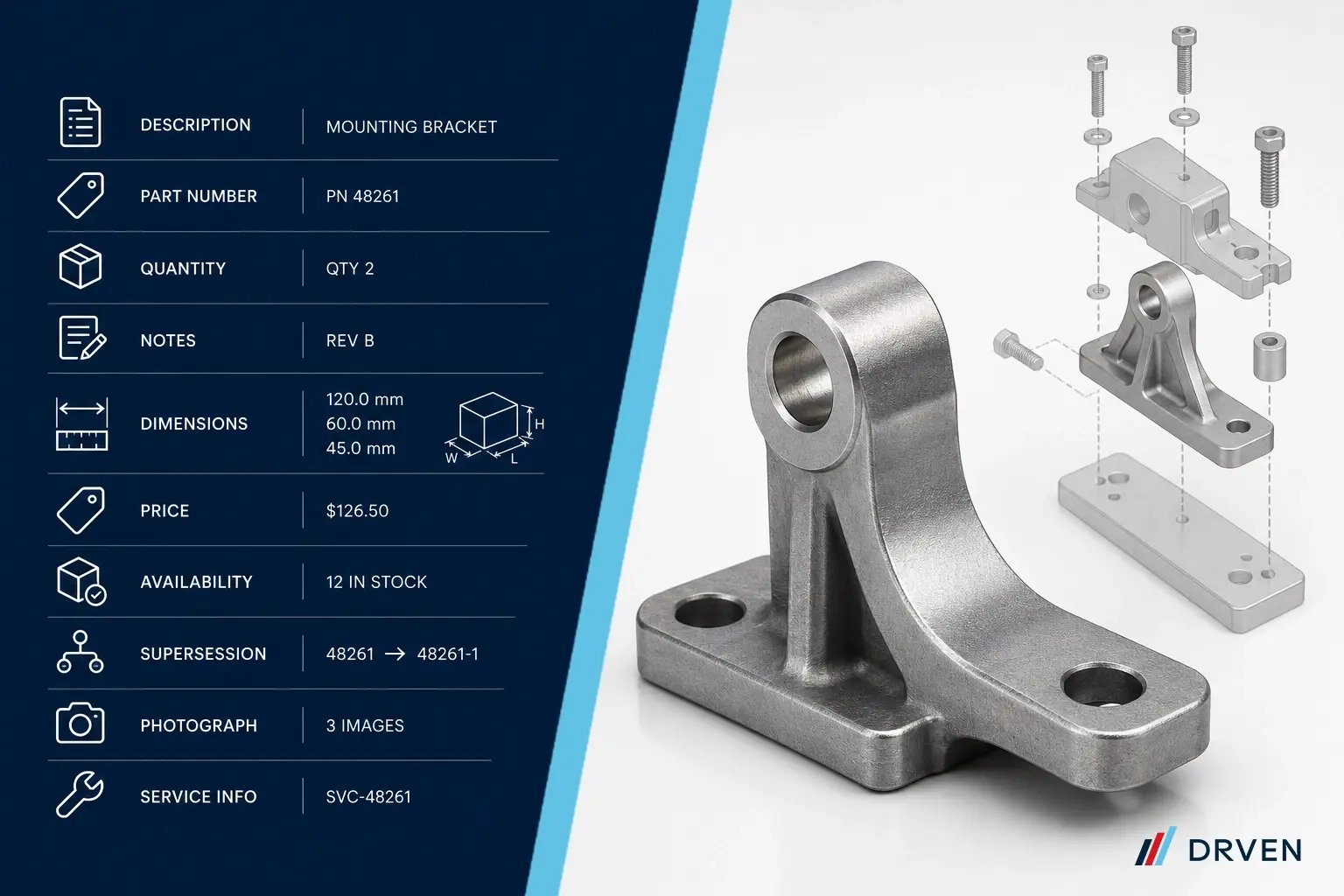
The parts record may also include a description, part number, quantity, notes, dimensions, price, availability, supersession history, photographs and links to service information.
There is a lot of data and logic held within an electronic parts catalogue beyond IDs and drawings.
The important bit, however, is the logic behind it, because any one product or machine may have several possible pumps, filters, control units or brackets that look almost identical. The electronic parts catalogue must therefore help to narrow those options down and guide the user to the one that actually fits to prevent issues related to mis-ordering of spare parts, or excessive scrap.
That challenge is familiar in automotive, but it is certainly not unique to it. The same problem exists for agricultural machinery, construction equipment, marine engines, industrial systems, material handling equipment and almost any manufactured product that needs to be maintained over a long working life.
Before the EPC: the age of printed parts catalogues
For much of the twentieth century, the parts catalogue was a physical object. Usually a very large one!
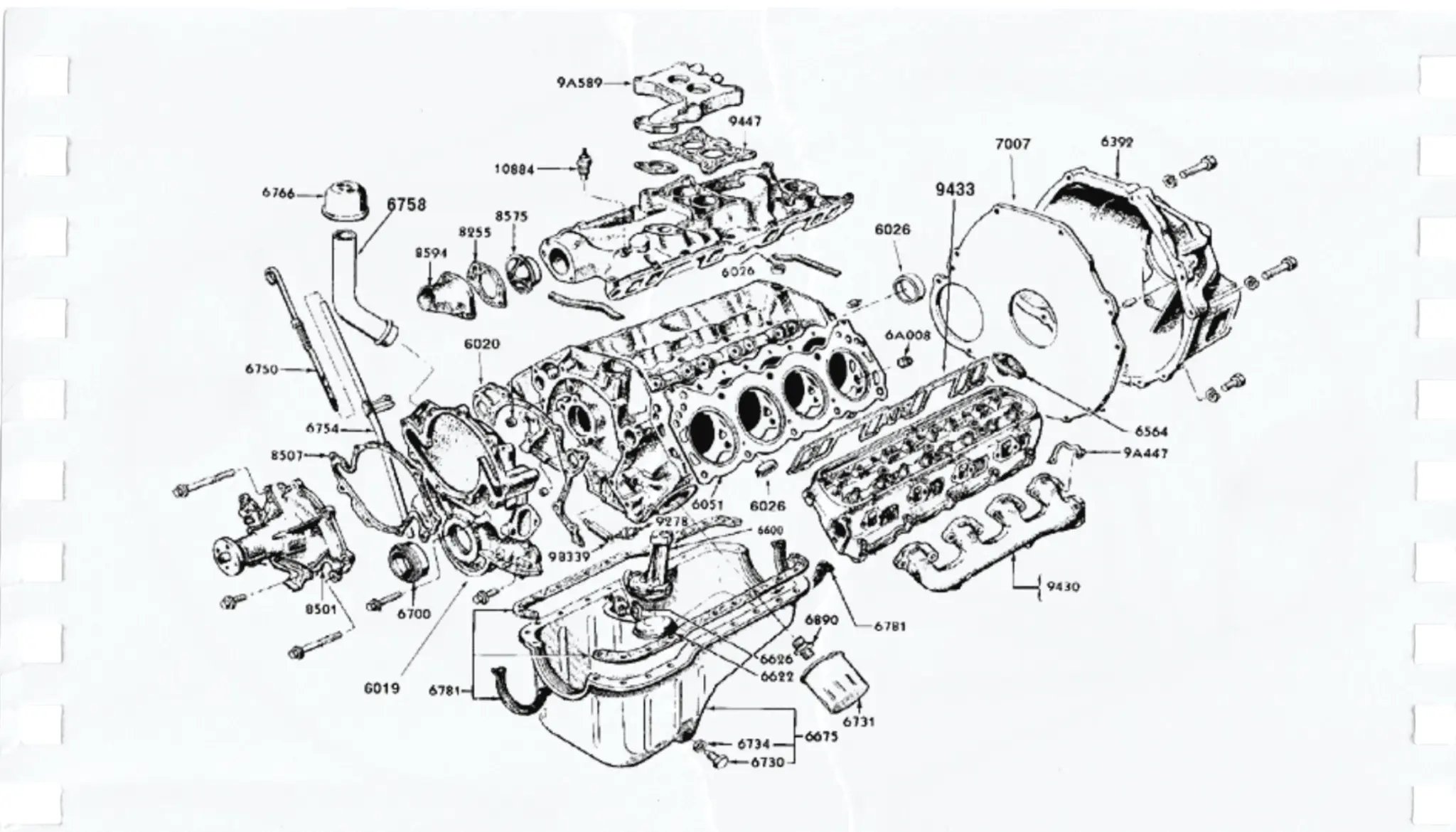
Dealers and service centres kept shelves of printed books and multi-volume binders. An illustration showed the assembly, numbered callouts identified its components, and a parts list provided the corresponding part numbers. The basic visual language was effective, which is why it still remains recognisable today in modern electronic parts catalogue software.
What a parts catalogue looked like in printed manuals (and even some EPCs still today).
Paper had obvious limits though. Products changed, parts were replaced or superseded, new variants appeared. A catalogue could therefore be out of date soon after it was printed, while distributing revised pages across a dealer or distributor network was slow and expensive.
The problem became harder as product ranges grew. A single machine platform could be sold with different engines, transmissions, cabs, hydraulic systems, electrical packages and regional specifications. The catalogue had a job to do to describe all of those combinations without causing the user to choose the wrong part.
Over time, experienced parts people learned how to interpret the books, and knew where manufacturers hid particular assemblies, which notes needed close attention and where errors were likely. That knowledge was valuable, but it was also difficult to scale.
Microfiche made distribution easier, not identification
(Ok, some of you might be wondering what a microfiche is, but bear with me while I show my age!)
By the 1960s and 1970s, many manufacturers had recognised the cumbersome nature of many printed manuals and started to use microfiche (or roll film) to essentially reduce the cost and physical bulk of catalogue publishing.
Example of a technician using microfiche to identify machine parts in the 1960's.
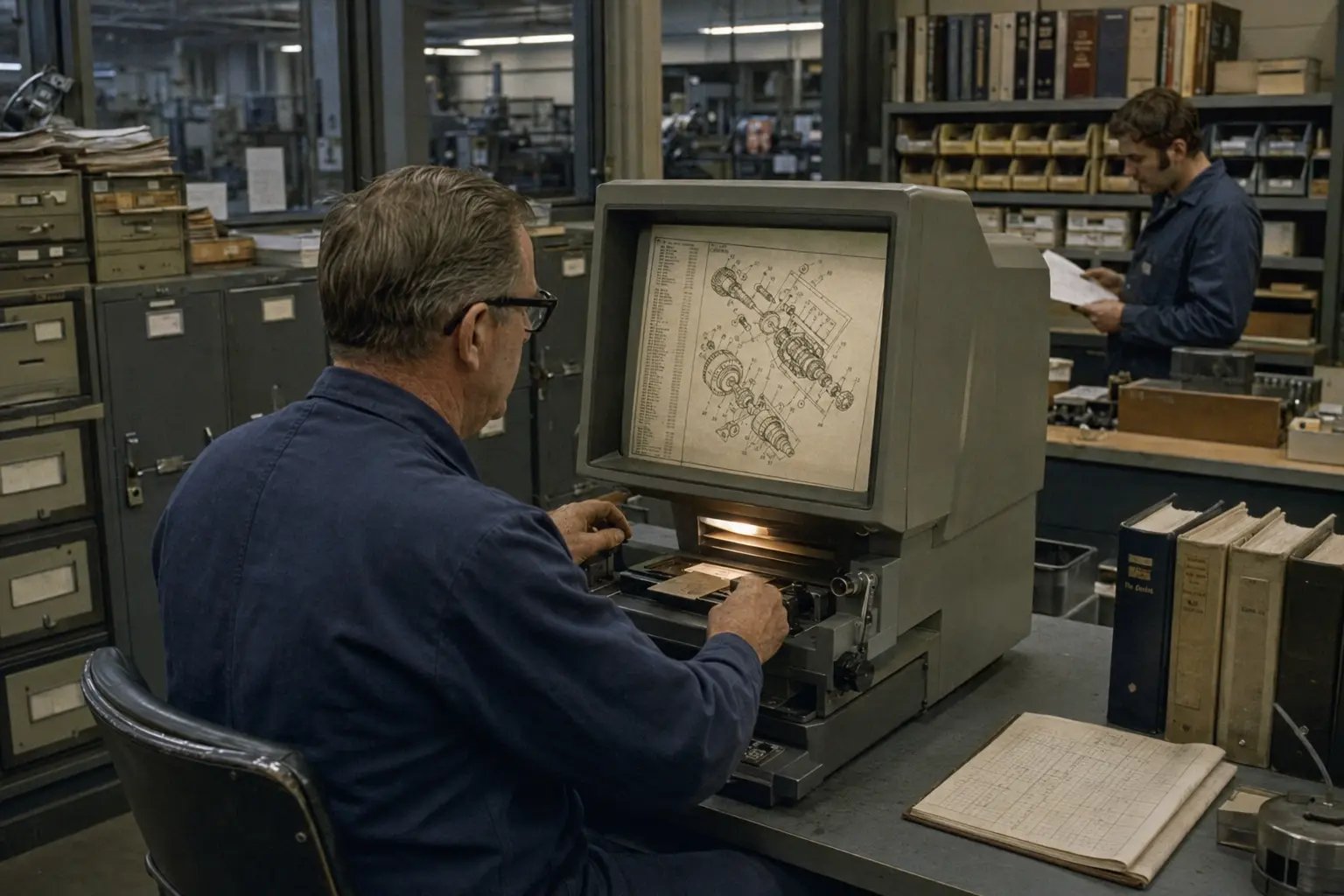
It solved a storage and distribution problem, but did not fundamentally change the identification process as it was still the same documents and drawings, just reduced to a format that didn't require an internal library. Users still had to navigate the manufacturer's structure, find the right illustration and interpret the available part-number choices.
In other words, the catalogue had changed format, but not yet become intelligent.
The arrival of the electronic parts catalogue
Electronic parts catalogues then began to emerge during the 1980s, with early systems moving the same familiar catalogue structure onto a computer, which made it easier to store, search and even distribute content saved onto floppy disks.
At first, that could feel like little more than a printed catalogue on a screen, however digitisation made several important capabilities possible:
- faster keyword and part-number search
- links between illustrations, callouts and parts records
- more frequent catalogue updates
- automatic handling of part supersessions
- some connections to dealer, inventory and ordering systems
- filtering by a VIN, serial number or known product configuration
That final point changed everything!
Instead of asking a user to interpret every production break, option code and fitment note, the EPC could effectively apply configuration data in the background. Parts that did not fit the selected machine could be removed from view, while the catalogue itself became quicker to use and, more importantly, safer to rely on.
This is where the electronic parts catalogue stopped being only a publishing format and became a working business system.
Why parts catalogue data became more complex
Cast forward to today and modern products now contain more components, more electronics and far more possible configurations than their predecessors.
A passenger car is an obvious example, but the same is true of a combine harvester, excavator, crane, generator or marine propulsion system. Two machines with the same model name may have been built in different factories, in different years and with different engines, attachments, control systems or customer-selected options.
This therefore creates a simple question with a complicated answer: which part fits this particular asset?
A useful electronic parts catalogue needs to understand more than a model name. Depending on the product, it may need to account for:
- VIN or serial-number ranges
- production dates and engineering change points
- factory-installed options
- regional specifications
- engine, powertrain or control-system variants
- attachments and later modifications
- part supersessions and approved alternatives
This is why a good EPC is actually quite difficult to build. The screen is only the visible part, while underneath the part sits a large amount of structured data, product hierarchy and applicability logic that must remain accurate as the product and parts estate changes.
How an electronic parts catalogue works
Although every manufacturer has its own terminology, most parts catalogues follow a similar route:
- Select the product, model or individual asset.
- Navigate to a major system, such as engine, hydraulics, electrical or chassis.
- Open the relevant subgroup and exploded-view illustration.
- Choose the component using its callout.
- Apply serial-number, VIN, build or option data to identify the applicable part number.
- Check supersession, price and availability, then pass the part into the ordering or service process.
The best systems shorten this journey so that a user may start with a serial number, keyword, visual selection, diagnostic code or service job rather than working through the full hierarchy.
DRVEN automates 3D visualized parts catalogues directly from engineering and sales data.
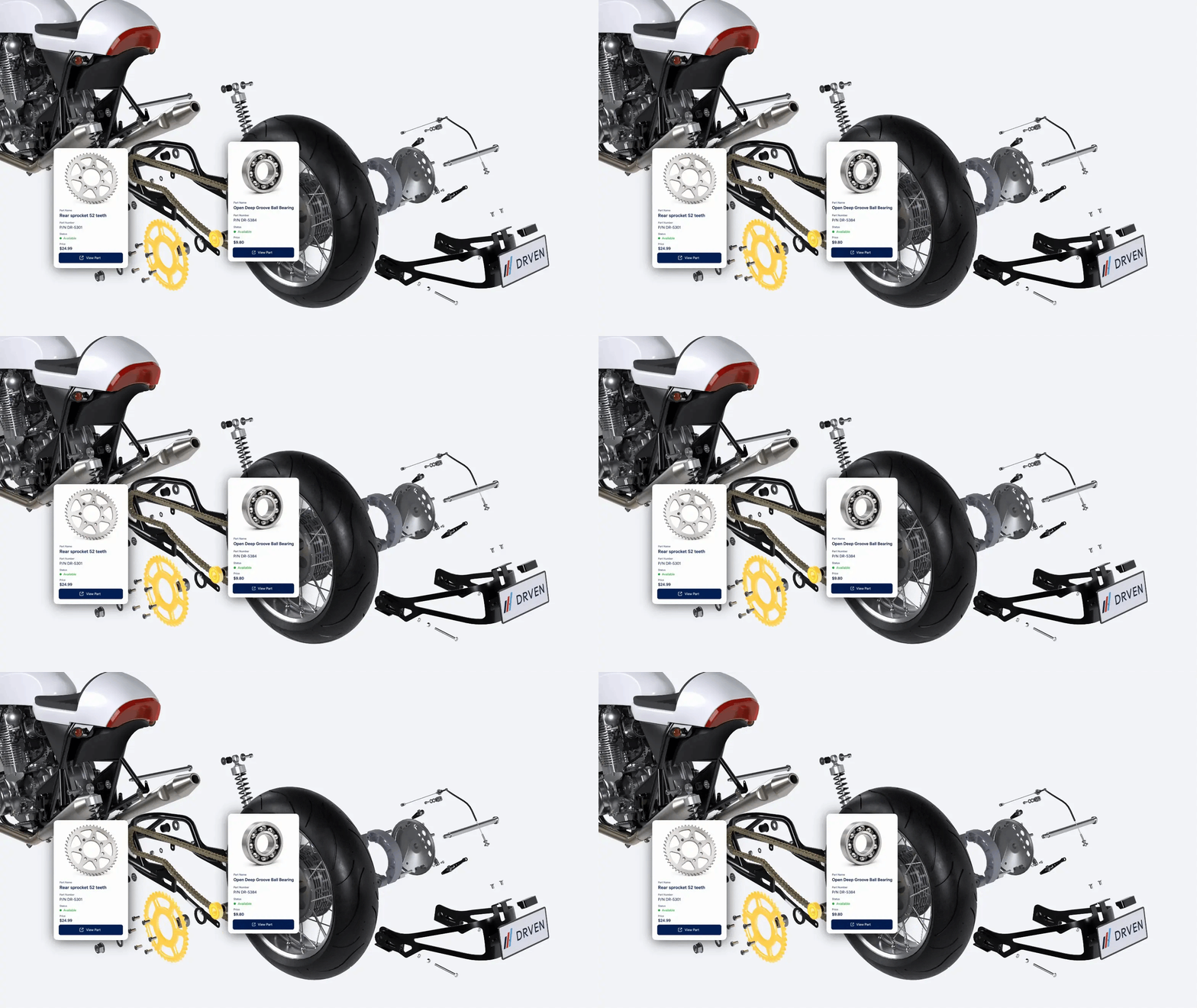
But there is a balance because simplifying the interface must not hide the evidence that gives the user confidence. A technician or parts adviser often wants to see the assembly around the component, check adjacent items and understand why a specific part has been selected. The illustration and underlying parts catalogue structure provide that context.
Who uses an electronic parts catalogue?
The traditional answer would be the parts department, but like many departments and job functions today, we have evolved our approach to technology, digitisation and data that means this is no longer enough.
An electronic parts catalogue may now be used directly, or supply data to systems used by:
- dealer and distributor parts teams
- field and workshop technicians
- technical support teams
- service managers and warranty administrators
- fleet and asset operators
- independent repairers
- customers buying parts online
- product, engineering and aftermarket teams
Each audience actually needs something slightly different. A trained parts specialist may want speed and dense information, a customer needs clarity and reassurance, and a field technician may be working on a phone with poor connectivity. Trying to serve all three with the same interface usually creates compromise, and so this also now needs reflecting in EPCs in terms of roles and access rights, different UIs and different ways or displaying the information. A technician will be far more comfortable than an end user at diagnosing issues or identifying spare parts, and familiar with how to use EPCs, while a consumer looking to replace a small part in their pressure washer is more likely to look at the same EPC and struggle.
The underlying catalogue data can be shared with all these personas, but the experience needs to suit the job being done, and the experience or knowledge of the person undertaking the work.
The EPC has moved beyond parts identification
This is the biggest change in the role of the electronic parts catalogue, because while the catalogue used to be the place where someone looked up a part number, its data and logic now supports a much wider set of aftermarket processes. Here we look at some of the downstream benefits:
Parts eCommerce
An online parts store is only useful if customers can not just find the parts, but also buy the correct items too. Electronic parts catalogue data provides the product structure, illustrations, descriptions and fitment rules needed to make that possible. Serial-number or VIN filtering can reduce incorrect orders and give buyers more confidence.
Service quotations and repair planning
Parts data can also be combined with other data, such as labour operations, procedures and pricing, to create more accurate service quotations. The user starts with a repair need and the system determines the parts required to complete the job.
Inventory and demand planning
Catalogue relationships help manufacturers and distributors understand which products use a particular part. Combined with installed-base and sales data, that can support stocking decisions, obsolescence planning and forecasting.
Technical support and self-service
Clear illustrations and accurate product filtering reduce the need for customers and technicians to ask support teams to identify routine items. When support is needed, both sides can refer to the same assembly, callout and part information.
Fitment validation
Catalogue logic can also check whether a selected component is suitable for a particular asset, which is valuable wherever an incorrect part creates delay, repeat work, returns or safety risk.
Why manufacturing companies still struggle with EPCs
The technology has improved, but many of the hard problems remain, specifically related to data access.
Most of the time manufacturers already hold the information needed for an excellent electronic parts catalogue across several disconnected systems.
-
Engineering owns CAD and the engineering bill of materials.
-
Manufacturing works from another product structure.
-
Service teams create their own descriptions, kits and repair logic.
-
Commercial systems hold pricing and availability.
-
Product configuration may sit somewhere else again.
Turning all of that into clear, service-ready catalogue content therefore can take a lot of work.
Common problems include:
- catalogue content that is already behind the engineering change process
- inconsistent part descriptions and product hierarchies
- poor or incomplete serial-number applicability
- illustrations that are difficult to interpret on modern screens
- missing photographs for parts that users recognise visually
- separate catalogue, eCommerce and service systems using different versions of the truth
- too much dependence on a small number of experienced employees
The effects appear across order accuracy, machine downtime, support workload, inventory and customer trust.
From CAD to catalogue
Every serviceable part starts upstream when the product is designed in CAD. It's then managed through product lifecycle systems and represented in engineering and manufacturing bills of material before it ever appears in an aftersales parts catalogue.
Yet the handover into aftersales is almost always an afterthought and fragmented. Data is exported, reshaped and re-entered, which means that the context disappears, and service teams then have to rebuild relationships that were already known during product development.
I personally think this is where the next major improvement will come from by creating a stronger, less fragmented connection from CAD to catalogue because it allows engineering intent, product configuration and serviceability information to move through the product lifecycle with less manual reconstruction. Ultimately, it ensures that the digital parts catalogue becomes a service-ready expression of the product - not a separate publication created at the end.
That does not remove the need for aftersales expertise. Engineering structures are not always suitable for a technician or customer. Service kits, repair groupings, supersessions and useful descriptions still need careful thought. But the starting point becomes better, and changes can flow through more reliably because the change in the product can quickly be visualised in the digital catalogue, rather than a disparate flow of processes and information that leads to an updated parts catalogue 6 months later.
Watch this DRVEN Demo - See how to generate a 3D immersive parts catalogue directly from CAD data
The electronic parts catalogue as part of the digital thread
Manufacturers talk a lot about the digital thread. In practical terms, it means keeping useful product information connected as it moves from design through production and into service.
Read about our Digital Thread Maturity Framework for OEMs in a previous article
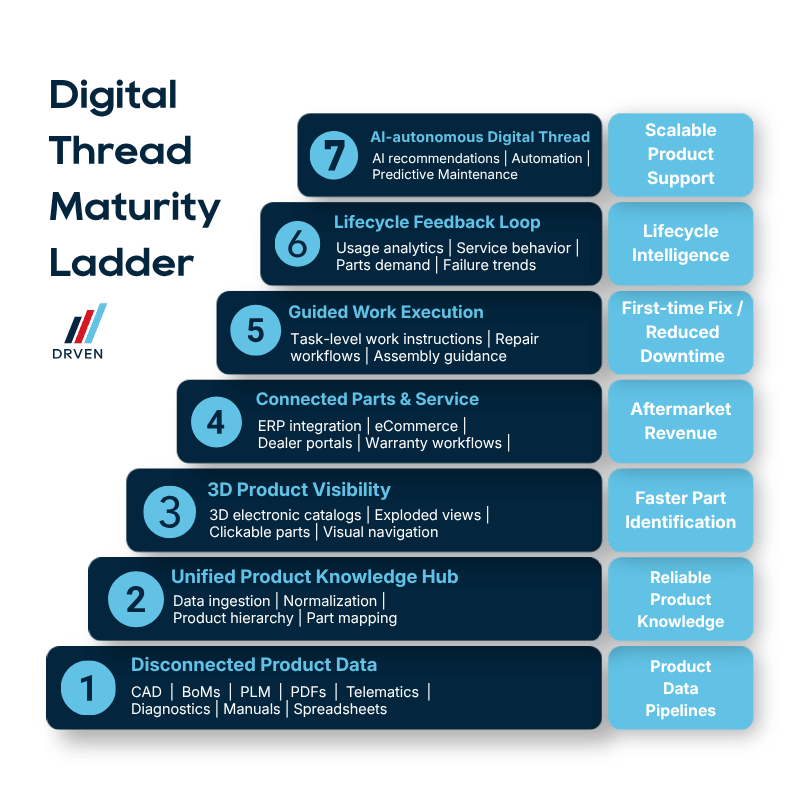
For aftermarket operations, the chain might run from CAD and PLM, through engineering and manufacturing bills of materials, into product build records, parts catalogue content, service systems and customer-facing applications.
The electronic parts catalogue is an important point in that chain because it translates complex product information into something that can be used when a machine is down, a technician needs an answer, or a customer is ready to buy.
I like to describe that wider process as Discover, Determine and Deliver:
- Discover what the asset needs, using symptoms, inspections, diagnostics, service history or connected data.
- Determine the correct solution, using configuration, fitment, parts and service logic.
- Deliver the outcome through availability, pricing, ordering, workshop planning and customer communication.

The electronic parts catalogue ultimately sits at the centre of Determine, but its value grows when it is connected to what happens before and after the lookup.
What comes next for electronic parts catalogues?
As you can see, from parts libraries to microfiche and up to the EPC platforms of today, I've seen and experienced many different ways that OEMs have distributed spare parts catalogues. I've even been the one building them myself, but now at DRVEN we're at the forefront of the next wave of EPCs where the future is not going to be a bigger standalone catalogue with more menus.
Users now expect to start with the information they already have: a serial number, photograph, diagnostic code, symptom, service event or connected-machine alert. The system therefore needs to combine those signals with product configuration and catalogue logic, and then present a clear answer.
Artificial intelligence will 100% have a role, particularly in search, image recognition, content enrichment and support. However, just like all industries, an AI-generated answer is only useful if it is grounded in accurate parts data and applicability rules. Guessing the most likely part is not the same as identifying the correct one.
The manufacturers that make progress will treat the data that underpins the electronic parts catalogue as a reusable operational asset. They will connect it to engineering, keep it current and deliver it through experiences designed for different users.
A catalogue is no longer just a catalogue
The parts catalogue has travelled a long way from printed books and microfiche. Its basic purpose remains the same however: help someone identify the correct replacement part. It's just that everything around that purpose has expanded.
A modern electronic parts catalogue can support the dealer, the technician, the distributor, the support team and the customer. It can power eCommerce, service planning, inventory decisions and self-service. It can also connect downstream aftermarket work with the product knowledge created upstream in engineering and manufacturing, and by harnessing insights into aftermarket and parts identification data it enables OEMs to finally move towards a predictive approach to maintenance and repair.
That makes the EPC sometimes easy to underestimate by some because they still see it as one system among many. In reality, it can be the shared product knowledge hub powering a large part of the aftermarket experience.
So, for a customer with a machine or product out of service, the quality of that product intelligence in the EPC is now fundamental to how quickly work resumes!